EARLY ACCESS
A private FinOps agent that shows its work.
Mission FinOps Agent is being designed to answer AWS cost questions using approved evidence while exposing the support, contradictions, missing data, confidence limits, ownership, and next decision behind every answer.
Mission FinOps Agent is not generally available. Early Access is for a limited number of design partners with a real AWS cost question, an agreed evidence boundary, and willingness to provide structured feedback. Capabilities, interfaces, deployment options, and commercial terms may change.
The intended workflow.
- 1
- Ask a material AWS cost question.
- 2
- Build or load the approved evidence record.
- 3
- Calculate cost and usage facts deterministically.
- 4
- Test explanations against supporting and contradicting evidence.
- 5
- State what remains missing.
- 6
- Produce an answer, confidence assessment, ownership context, and next decision.
- 7
- Require human review for material conclusions.
Where it runs, and the data boundary.
The intended design: the agent's own application and runtime deploy into the customer's AWS account, and it invokes Amazon Bedrock, AWS's own managed model service, using IAM credentials the customer controls, rather than sending evidence to infrastructure Mission FinOps hosts or operates. Bedrock itself is a multi-tenant AWS service, not something that runs inside the customer's account; invoking it means a request leaves the application and reaches Bedrock over the network, governed by the customer's own IAM policy and AWS's own Bedrock data-handling terms, not by an unqualified claim that data never leaves the account boundary. Where a customer's own network policy requires it, AWS PrivateLink can keep that Bedrock API traffic on the AWS network rather than the public internet. This is the design direction being built toward, not a claim that a customer-deployable package exists today: see the status note below.
The concept and implementation direction is published and versioned separately: github.com/MissionFinOps/local-ai-finops, an open architecture note (CC BY 4.0) specifying the boundary between deterministic calculation and model interpretation, independent of which model or hosting option a customer chooses.
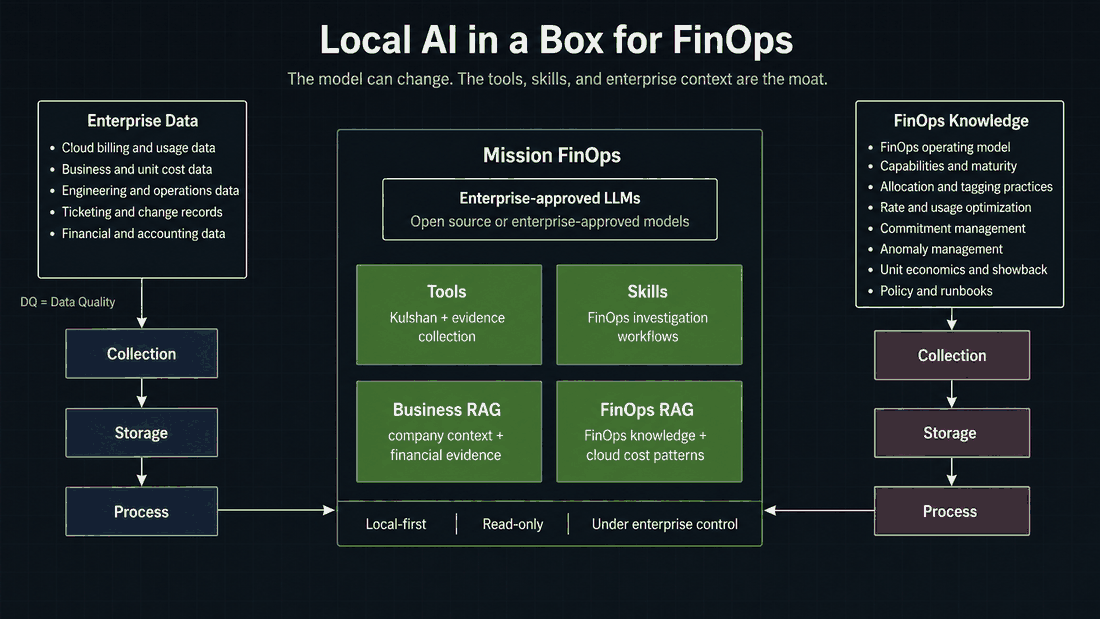
- •
- IAM and access: the agent operates under the customer's own IAM roles and permission boundaries, scoped to the requesting user or investigation, never the union of every connected user's access.
- •
- Evidence-bound: the model selects, quotes, and compares values a deterministic tool already calculated. It does not compute or estimate a monetary value itself, and cannot restate one without a calculation reference.
- •
- Deterministic calculations: aggregation, currency conversion, deltas, accounting-basis reconciliation, and confidence scoring run in approved tools (Kulshan is the first one), not in the model.
- •
- Human review: a material conclusion requires human approval before publication, with the reviewer, time, and disposition recorded.
- •
- Refuses unsupported conclusions: missing, delayed, or denied evidence is never interpreted as a clean result. A tool must reject an unsupported calculation request rather than let the model approximate it.
A synthetic worked example.
Adapted from the architecture note's own worked example. All values below are synthetic.
Question
Cost Explorer shows a 20% month-over-month increase. Why does the CUR-based cost report show only 3%?
Answer the agent is designed to give
These are not directly comparable: Cost Explorer's figure uses unblended cost, the CUR figure uses net-amortized cost, and 40% of the underlying CUR line items are missing a cost-center tag. That partial tag coverage is a separate, real gap, not the cause of the percentage difference. Recommended next step: run a basis reconciliation for the period, and resolve ownership for the untagged line items.
What it will not do
It will not average, round, or silently reconcile the 20% and 3% figures into one number, and it will not treat missing tag coverage as immaterial just because a comparability issue also exists.
Status, exactly as it stands today: Early Access is a customer-specific pilot deployment, scoped and built together with Mission FinOps for one design partner's actual AWS cost question, not a self-serve product a customer installs alone or waits for on a public roadmap. The architecture note, this synthetic example, and Kulshan (a separate, existing open-source building block that does not itself implement this full architecture) are published and available today. Business retrieval, FinOps retrieval, model orchestration, the query-authorization gate, and the finding validator are built out as part of each pilot's own scope and evidence boundary, not shipped as a packaged, generally-available product. Nothing on this page is a claim about deployment, privacy, or security guarantees beyond what a specific Early Access engagement actually implements and documents in writing with that customer.
Early capability areas.
Designed to, in Early Access:
- Cost inquiry over approved Cost Explorer, Data Exports/CUR, and Kulshan artifacts
- Evidence-backed variance explanations
- Ownership and account-context resolution
- Supporting, contradicting, and missing evidence
- Confidence limits
- Decision-memo and report generation
- Customer-controlled execution options
- Customer-controlled or approved model options where technically supported
- Repeatable investigation history
- Human review and approval
Explicit exclusions.
- No autonomous AWS remediation
- No production write permissions
- No invented cost calculations
- No silent use of customer data for model training
- No claim of complete root-cause certainty when evidence is missing
- No general-availability SLA
- No claim that every service, account, or billing model is already supported
Request Early Access.
Email hello@missionfinops.com with subject “Mission FinOps Agent Early Access,” answering:
- What recurring AWS cost question should the agent help answer?
- Who needs to trust the answer?
- What evidence is available?
- What execution or data-boundary requirements apply?
- What would make the Early Access evaluation successful?
There is no self-serve signup form yet. Every request is read and answered by Yuvdeep directly: nothing here implies a submission is stored or queued automatically.